力和運動
穩固
16/22
72.7%
勻速圓周運動 · 6/6 · 100.0%
動量 · 2/6 · 33.3%
位置和移動 · 4/4 · 100.0%
作功、能量和功率 · 2/4 · 50.0%
力、牛頓定律與力矩 · 2/2 · 100.0%
ORCA · 批改原卷
曾思穎
各課題得分佔該課題可得分數的比例
原卷 20 頁 · 已批註 40/46 題
第 1 頁
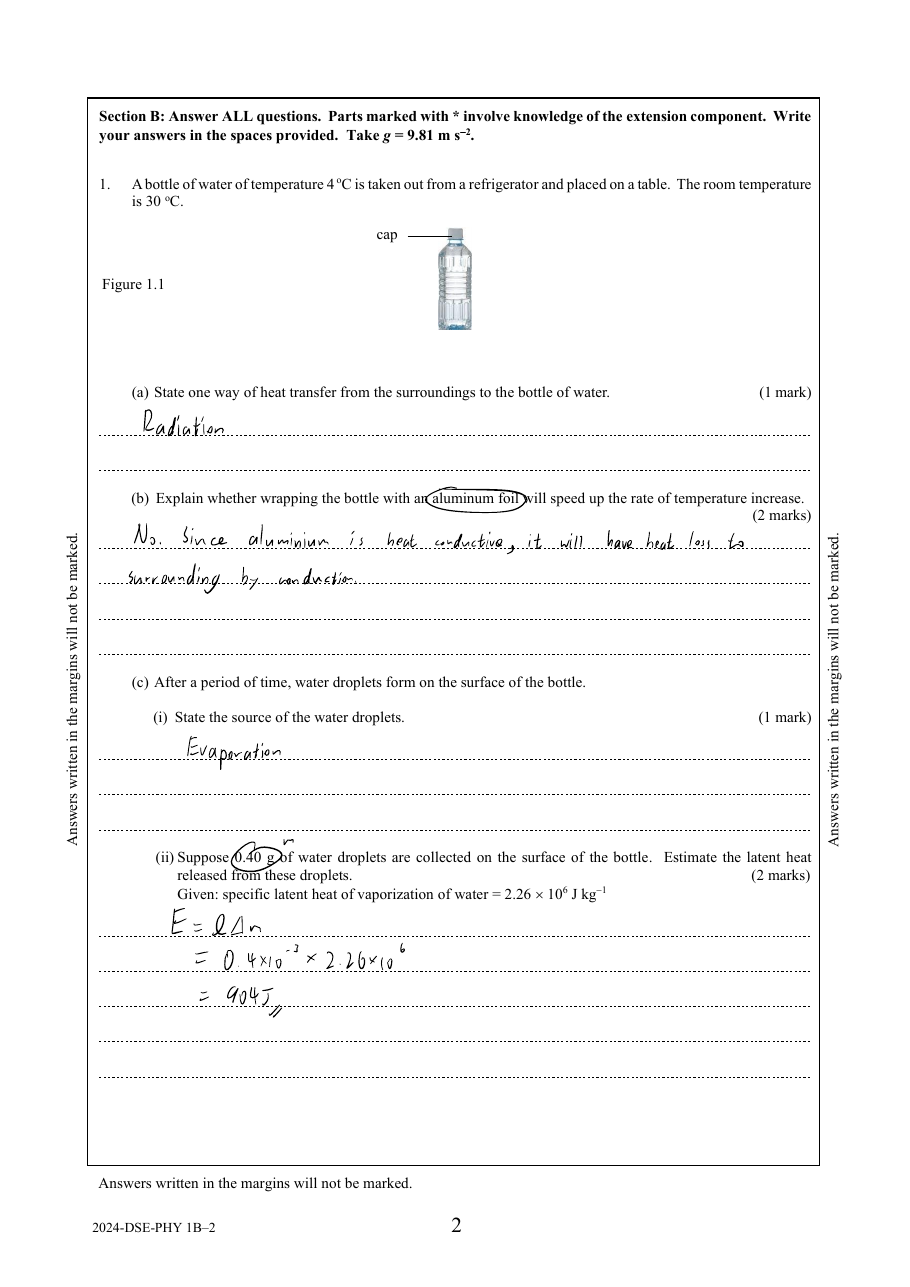
conduction / radiation — The student correctly stated radiation as a heat transfer method.
State 'Will not'. — The student correctly stated 'No', which is equivalent to 'Will not'.
Silvery surface of aluminum foil is a poor radiation absorber / good radiation reflector. — The student incorrectly explained heat loss by conduction instead of stating that the silvery surface is a poor absorber or good reflector of radiation.
The water droplets come from the moisture / water vapour in the air (surroundings). — The student stated a process ('Evaporation') instead of the source of water droplets (moisture or water vapour in the air).
Substitution: E = (0.40 x 10^-3)(2.26 x 10^6) — Correct substitution of mass and latent heat into the equation.
Answer: 904 J — Correct answer with unit.
第 2 頁
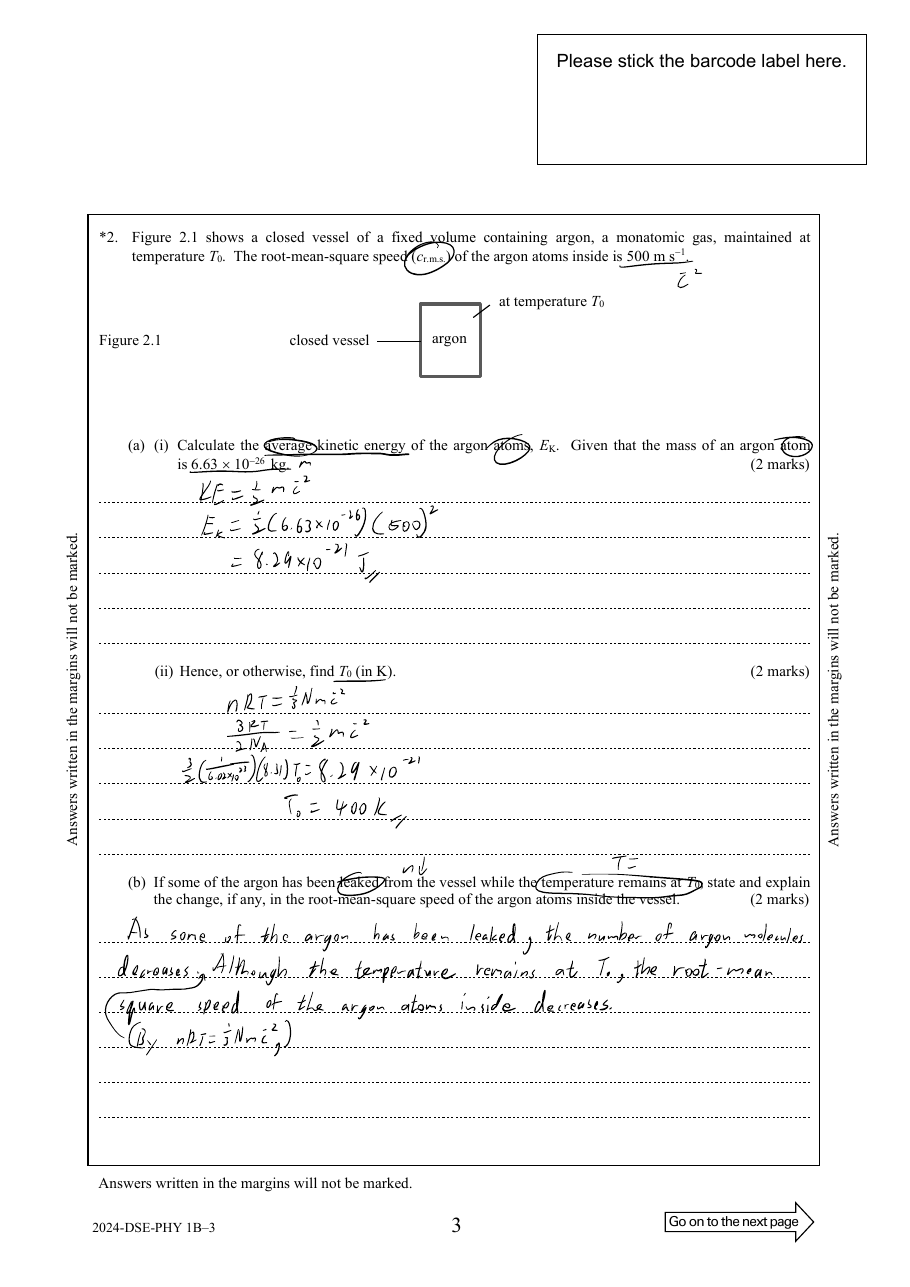
Substitution: Ek = 1/2 (6.63 x 10^-26)(500)^2 — Correct substitution into Ek formula.
Answer: 8.29 x 10^-21 J (Accept: 8.29 ~ 8.30 x 10^-21 J) — Correct final answer with correct unit.
Substitution into T0 = 2/3 * (Ek / R) * NA or equivalent formula. — Incorrect substitution into ideal gas kinetic energy formula.
Answer: 400 (K) — Prerequisite point 2aii_1 was not awarded.
State that temperature remains at T0. — Correctly stated that the temperature remains at T0.
Ek remains unchanged / cr.m.s. depends on temperature, so root-mean-square speed remains unchanged. — Incorrect conclusion; root-mean-square speed remains unchanged.
第 3 頁
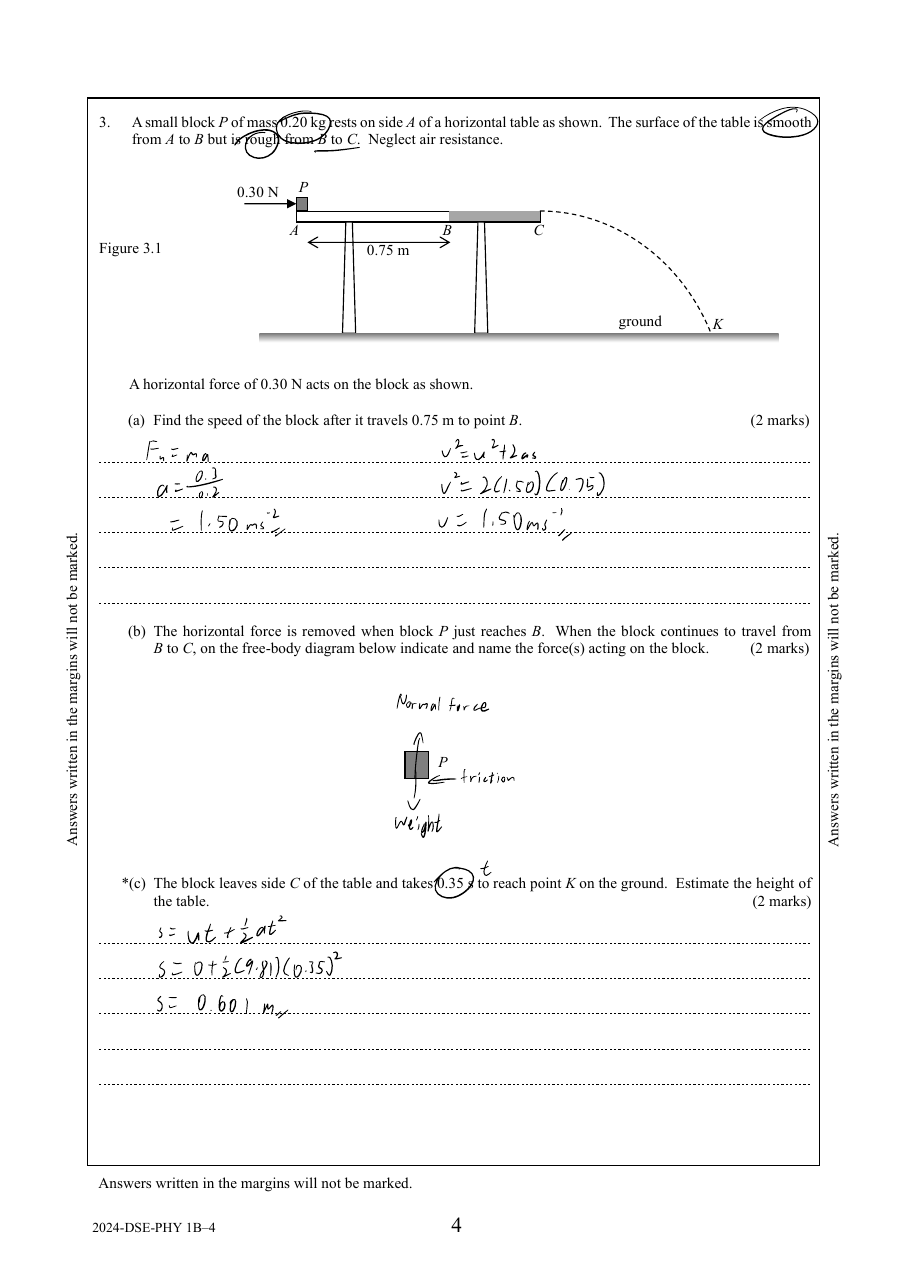
Substitution of values into work-energy equation (Fs = 1/2mv^2) or kinematic equations with F=ma. — Correct substitution into F=ma and kinematic equations.
Final answer v = 1.5 m s^-1. — Correct final speed.
[1/2] Correct identification and direction of at least two forces (Normal reaction upwards, Weight downwards, Friction to the left). — 學生在方塊 P 上畫出三個有箭嘴的力向量:由方塊頂部向上之垂直箭嘴標註「Normal force」、由方塊底部向下之垂直箭嘴標註「weight」,以及由方塊右側水平向左之箭嘴標註「friction」。因此至少兩個力的名稱及方向均明確正確。
[2/2] Correct identification and direction of all three forces with appropriate labels. — 學生的三個答案箭嘴均由方塊 P 邊緣出發:正常力箭嘴垂直向上、重量箭嘴垂直向下、摩擦力箭嘴水平向左;三者分別清楚標有「Normal force」、「weight」和「friction」。這與 MS 新加的三個力箭嘴及標註一致。
Substitution into vertical displacement formula s = 1/2 gt^2 using g = 9.81 and t = 0.35. — Correct substitution into vertical displacement formula using g = 9.81 and t = 0.35.
Final answer for height in range 0.60 m to 0.613 m. — Final answer 0.601 m is within the accepted range of 0.60 m to 0.613 m.
第 4 頁
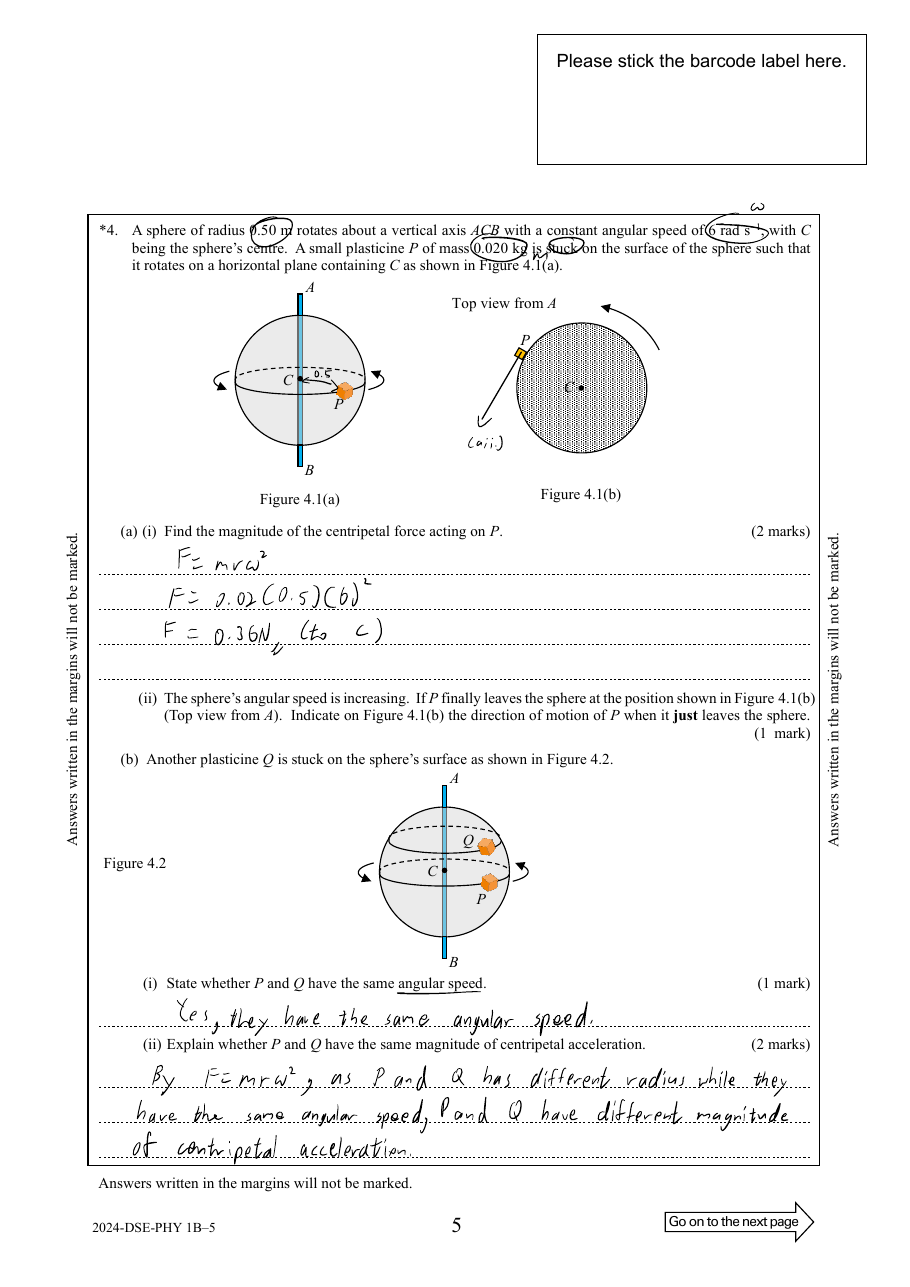
Substitution into centripetal force formula F = mω^2r. — Correct substitution into centripetal force formula F = m * r * w^2.
Final answer 0.36 N. — Correct final magnitude of 0.36 N.
State that they have the same angular speed. — Correctly states that P and Q have the same angular speed.
State that the magnitude of centripetal acceleration is different or smaller for Q. — Correctly states that P and Q have different magnitudes of centripetal acceleration.
Explain that this is because Q has a different or smaller radius (rQ < rP). — Correctly explains that the difference is due to different radius.
第 5 頁
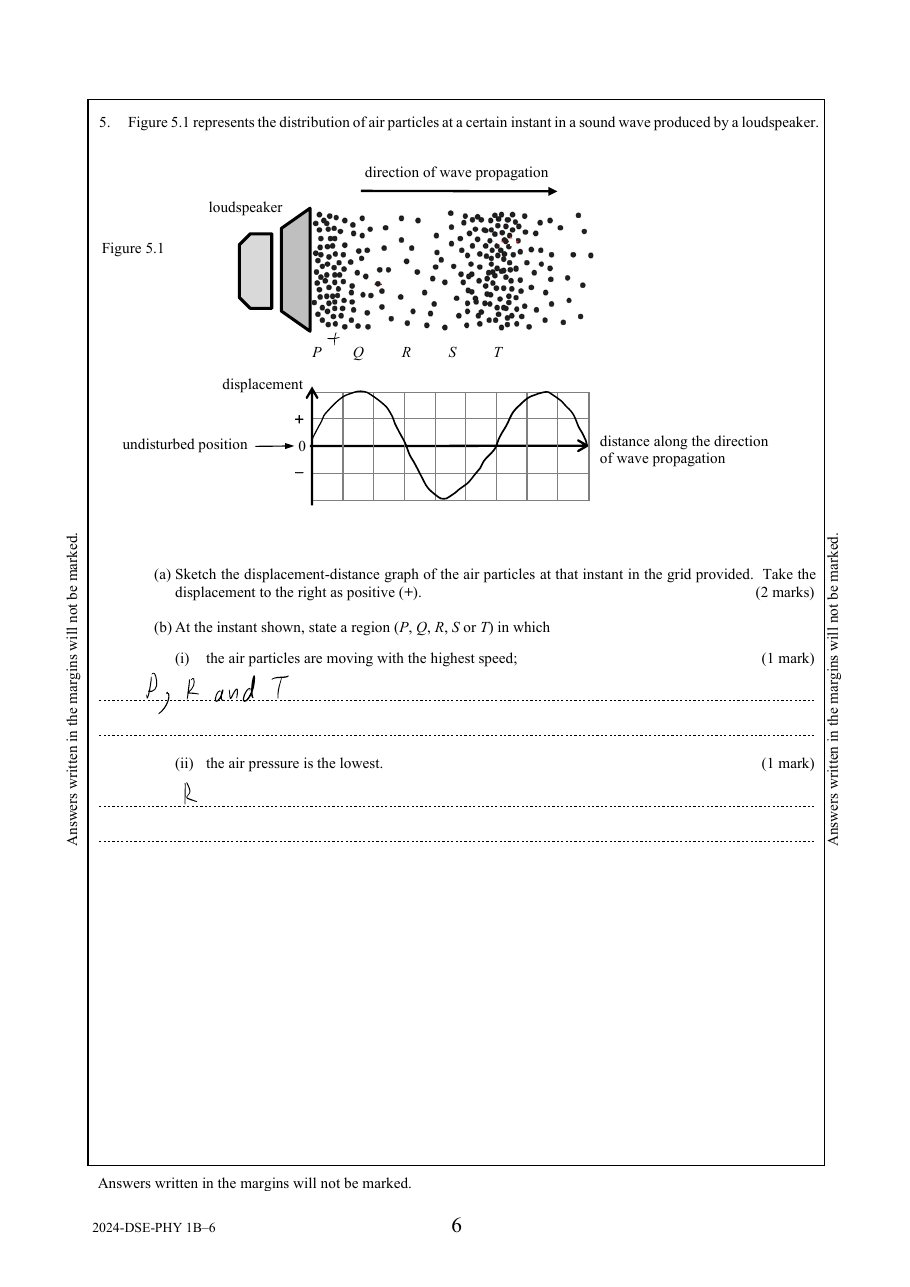
Identify any one of the points P, R, or T as being at momentary rest. — The student listed all three regions (P, R and T) instead of stating a single region as instructed, so no mark is awarded according to DSE rules.
Identify point R as the particle moving with the maximum speed. — The student correctly identified region R.
第 6 頁
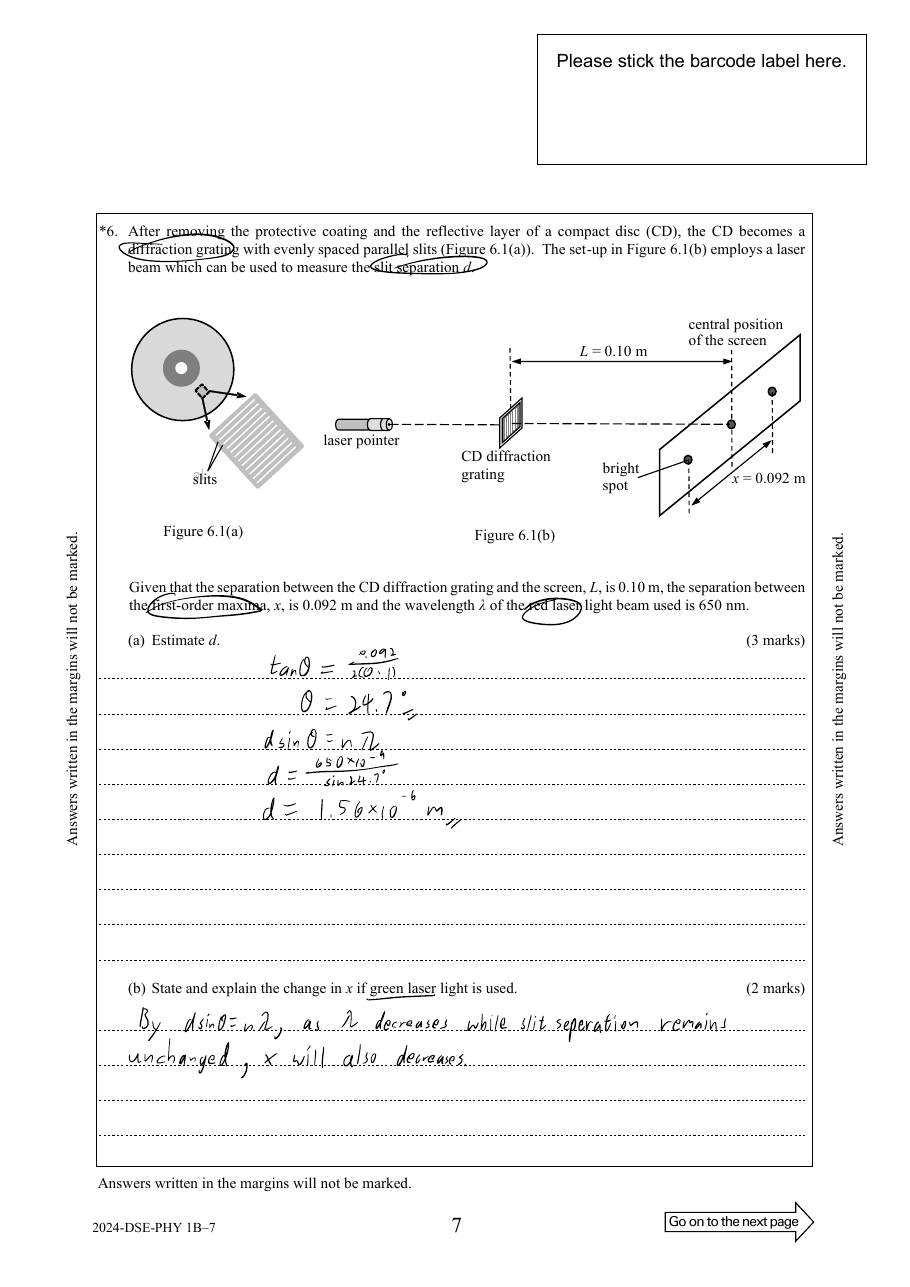
Correct substitution or calculation to find the diffraction angle θ (e.g., using tan θ = (x/2)/L). — The student correctly used tan θ = (x/2)/L to find the diffraction angle θ = 24.7°.
Correct substitution into the grating equation d sin θ = mλ. — The student correctly substituted values into the grating equation d sin θ = mλ.
Final answer for d is approximately 1.56 μm (Accept: 1.56 μm ~ 1.6 μm). — The student obtained the correct final answer for d as 1.56×10⁻⁶ m.
State that the distance x will decrease. — The student correctly stated that x will decrease.
Explain that as wavelength λ decreases, the diffraction angle θ (and sin θ) decreases. — The student correctly explained using the grating formula that a decrease in wavelength λ leads to a decrease in the separation x.
第 7 頁
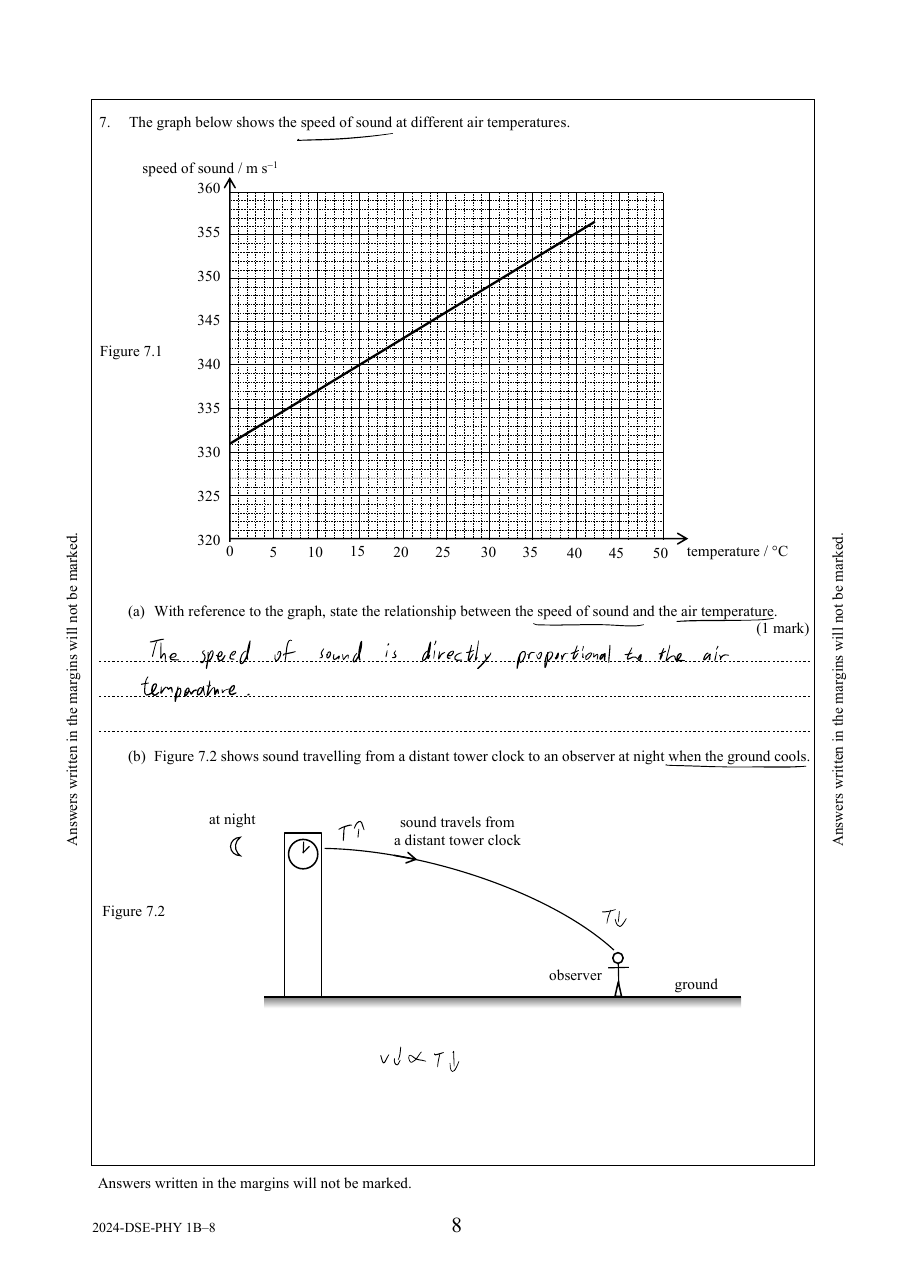
State that the speed of sound increases with air temperature. — Stating 'directly proportional' is conceptually incorrect because the speed of sound vs temperature graph in Celsius does not pass through the origin. The correct statement is that speed of sound increases with air temperature.
第 8 頁
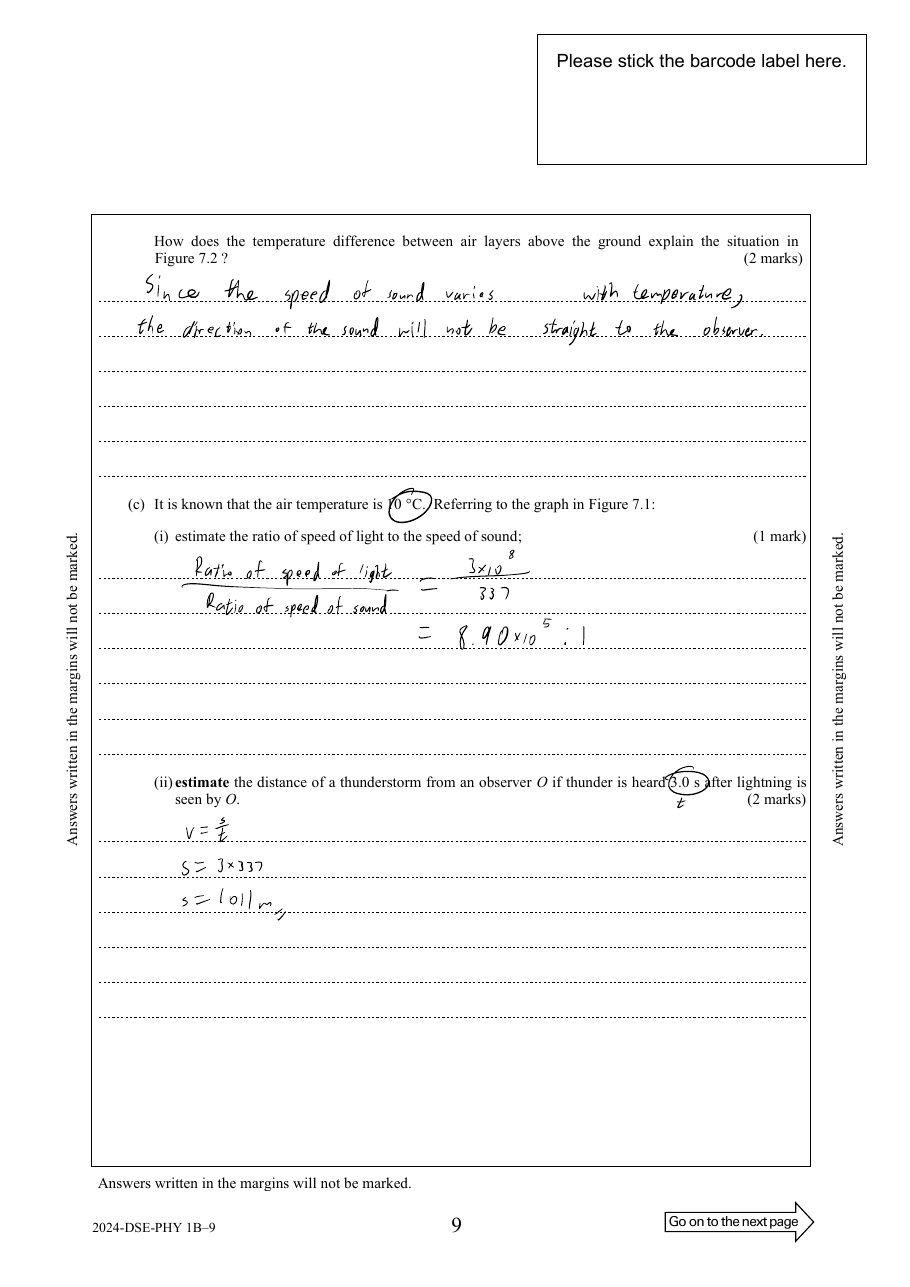
Identify that air near the ground is cooler while air layers higher above are warmer. — Failed to identify that air near the ground is cooler while upper air layers are warmer.
Explain that sound wave bends downward (towards the normal) due to refraction as it travels slower in lower temperature layers. — Failed to explain refraction/bending downward towards the normal due to lower speed in cooler lower layers.
Calculation of speed ratio (approx 8.90 x 10^5). — Correctly calculated speed ratio as 8.90 x 10^5.
Substitution into distance = speed x time (337 x 3.0). — Correct substitution into distance = speed x time.
Final answer 1011 m (Accept 1010 m ~ 1011 m). — Correct final answer of 1011 m with proper unit.
第 9 頁
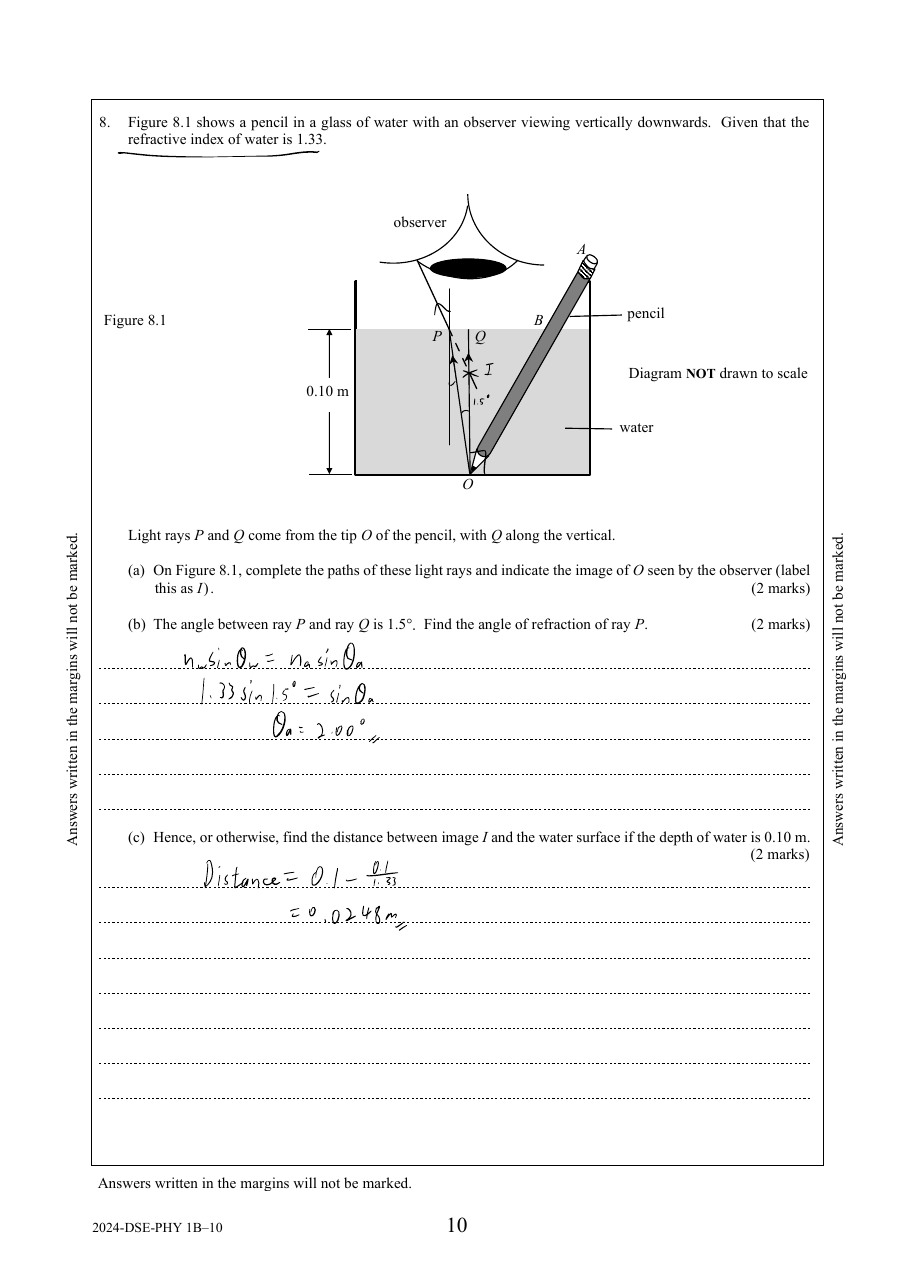
Substitution into Snell's Law: 1.33 = sin r / sin 1.5°. — Correct substitution into Snell's law equivalent to 1.33 = sin r / sin 1.5°.
Final answer r ≈ 2.00°. — Correct final angle of refraction of 2.00°.
Method using trigonometry (tan ratios) or the small angle approximation (real depth / apparent depth = n) to relate h and h1. — Correct method using small angle approximation ratio (apparent depth = real depth / n).
Final answer h1 ≈ 0.075 m (or 7.5 cm). — Incorrect final answer for image depth; gave displacement 0.0248 m instead of apparent depth 0.075 m.
第 10 頁
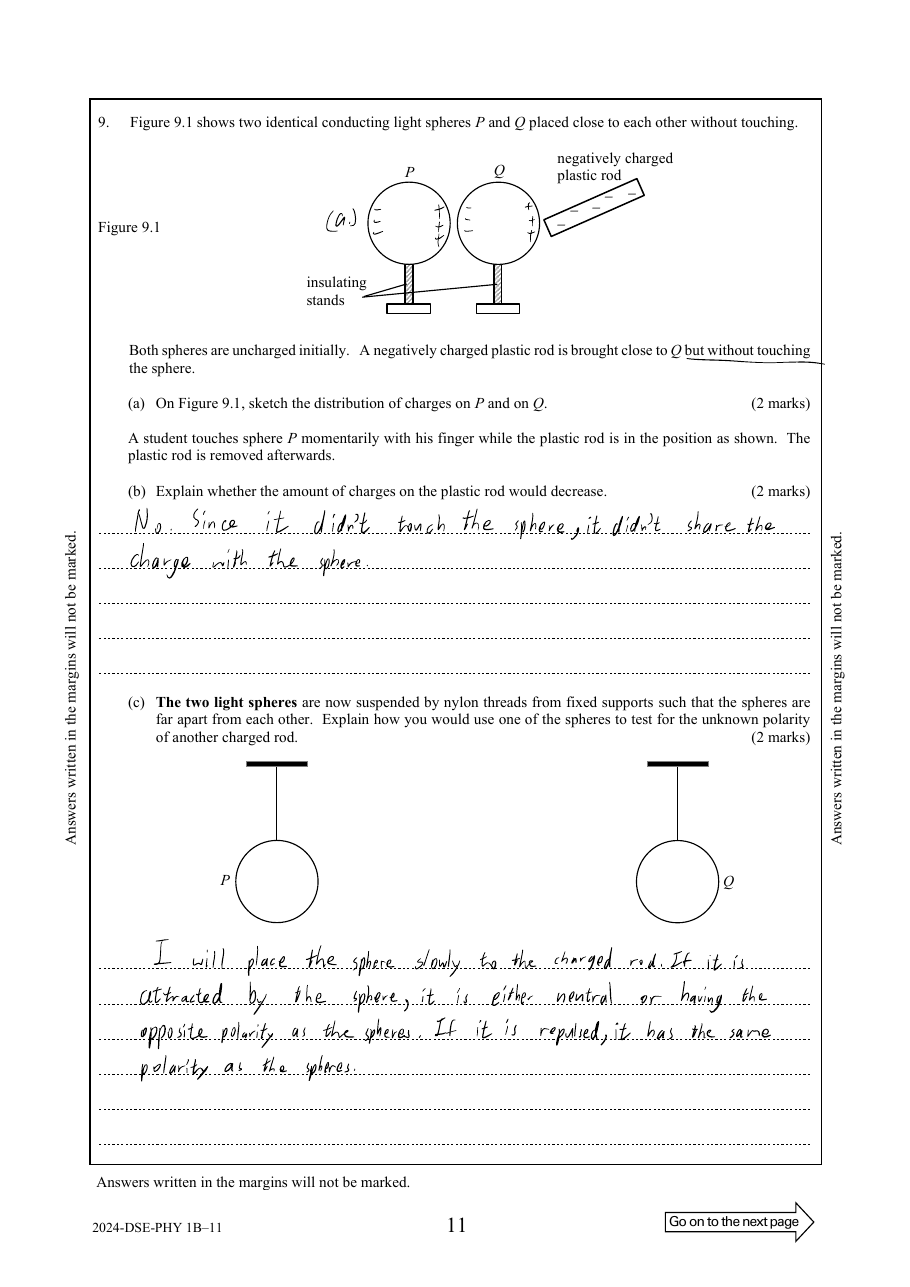
State that the charge remains unchanged. — Correctly states that the amount of charges on the rod does not decrease.
Explain that charging is through induction without contact or transfer of charges. — Correctly explains that process involves no contact and no transfer of charges.
Correct procedure to identify polarity: repulsion indicates positive charge; attraction indicates negative charge (1M for the correct procedure). — Correct procedure explaining that repulsion identifies same polarity and attraction identifies opposite polarity.
Bring the unknown charged rod near sphere P (which is positively charged) without touching it. — Does not explicitly state bringing the rod near without touching it.
第 11 頁
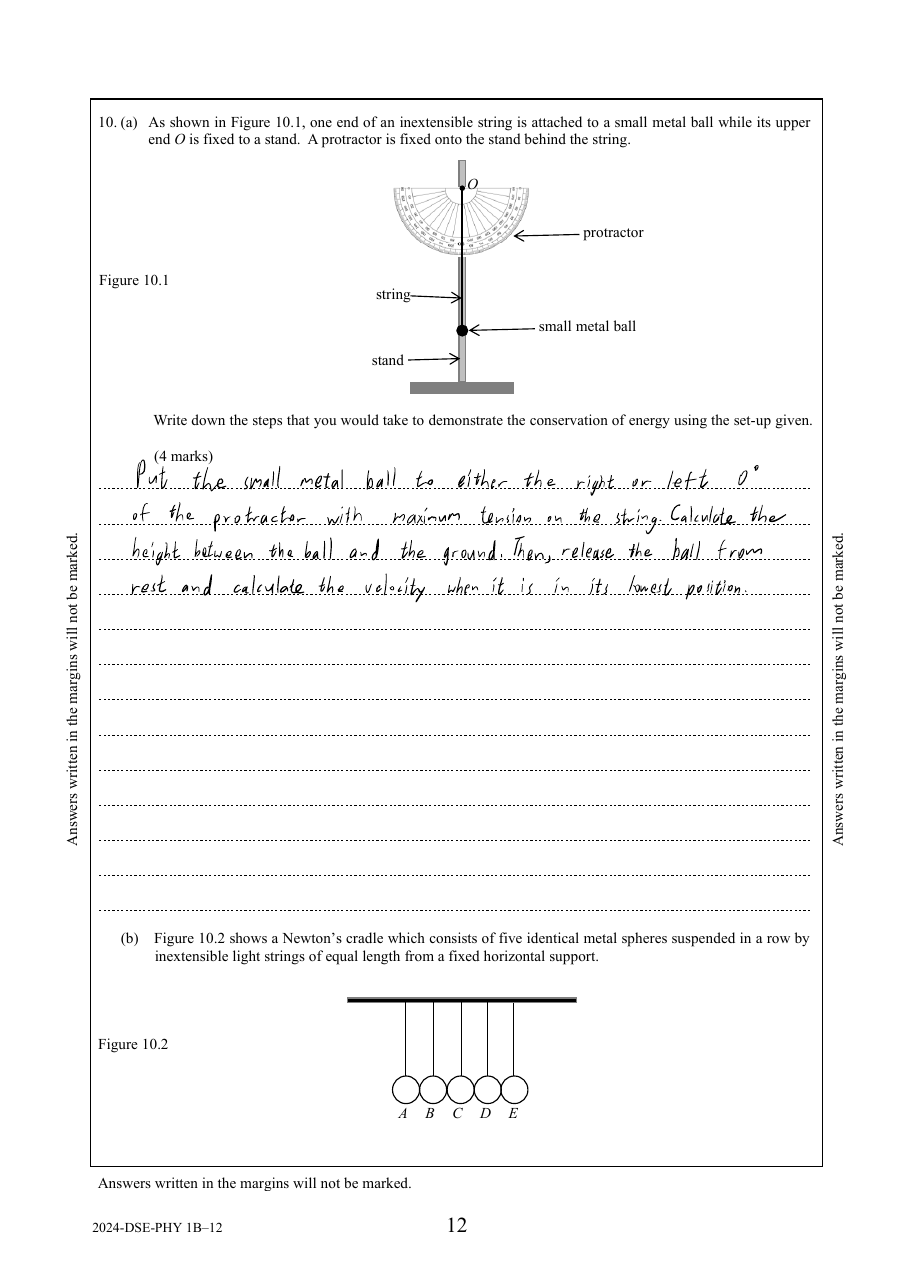
Measure/mark a specific release angle using a protractor. — The student mentions setting the ball at a specific angle using the protractor.
Release the ball from rest with the string taut. — The student describes releasing the ball from rest with the string kept taut (maximum tension).
Measure/observe the angle reached at the highest point on the other side (or return position). — The student incorrectly talks about calculating velocity at the lowest position instead of measuring or observing the angle at the highest/return position.
Compare initial and final angles; equality implies conservation of mechanical energy. — The student does not compare initial and final angles to show conservation of energy.
第 12 頁
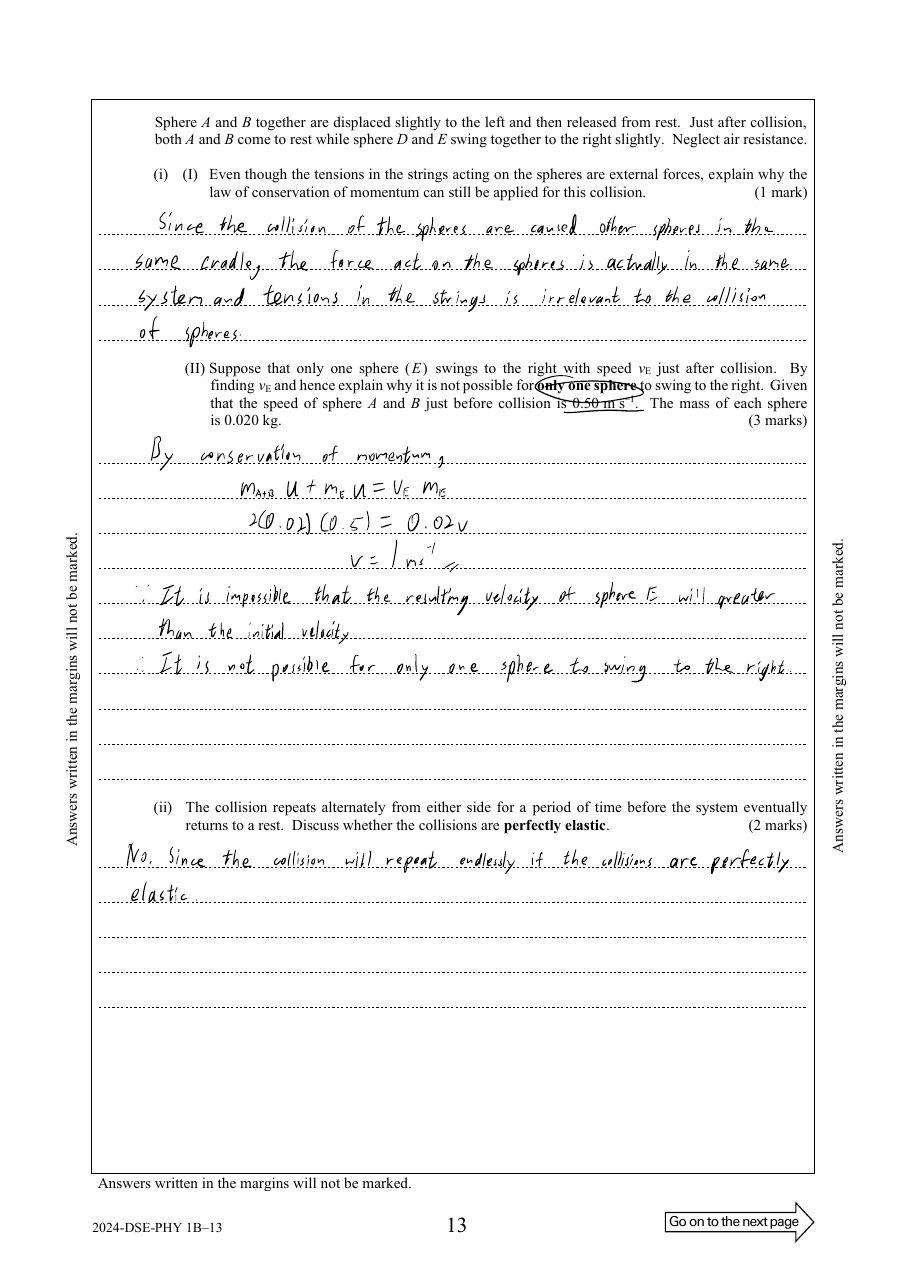
Calculate velocity of E using momentum conservation: vE = 1.0 m s^-1. — The student correctly applies momentum conservation to find the velocity vE = 1.0 m s^-1.
Calculate final kinetic energy (0.01 J) and compare it to initial kinetic energy (0.005 J). — The student does not calculate or compare the initial and final kinetic energy values.
Conclude that it is impossible because final KE cannot be greater than initial KE. — The conclusion is based on an incorrect reasoning regarding velocity comparison rather than showing that final kinetic energy exceeds initial kinetic energy.
State that the collision is not perfectly elastic. — The student correctly states that the collisions are not perfectly elastic.
Explain that kinetic energy is lost as sound or thermal energy. — The student does not state that kinetic energy is lost as sound or thermal energy.
第 13 頁
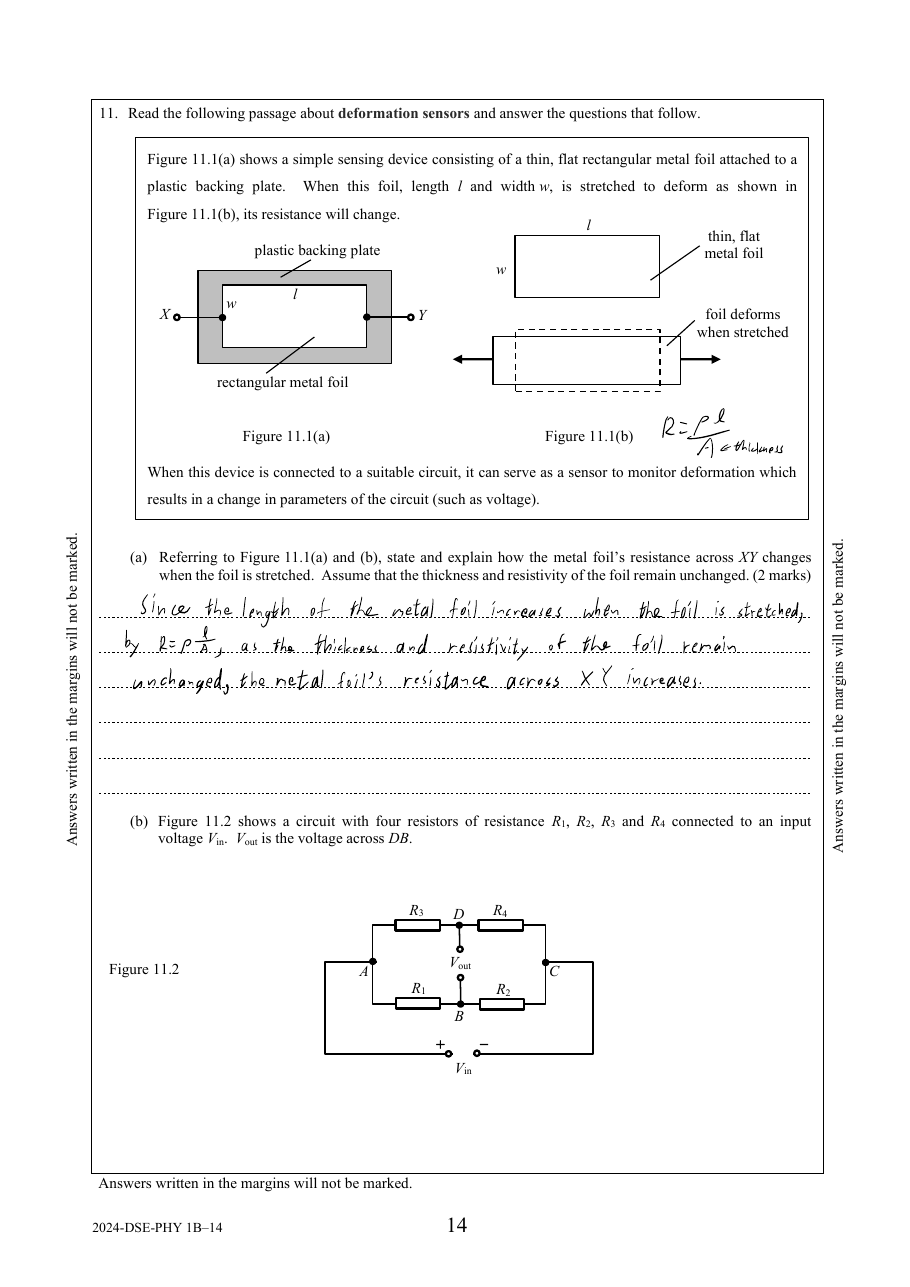
Conclude that resistance increases according to R = ρl/A. — The student correctly concluded that resistance increases according to R = ρl/A.
State that length l increases and cross-sectional area A decreases (due to decrease in width w). — The student mentioned that length increases, but failed to mention that the cross-sectional area (or width) decreases.
第 14 頁
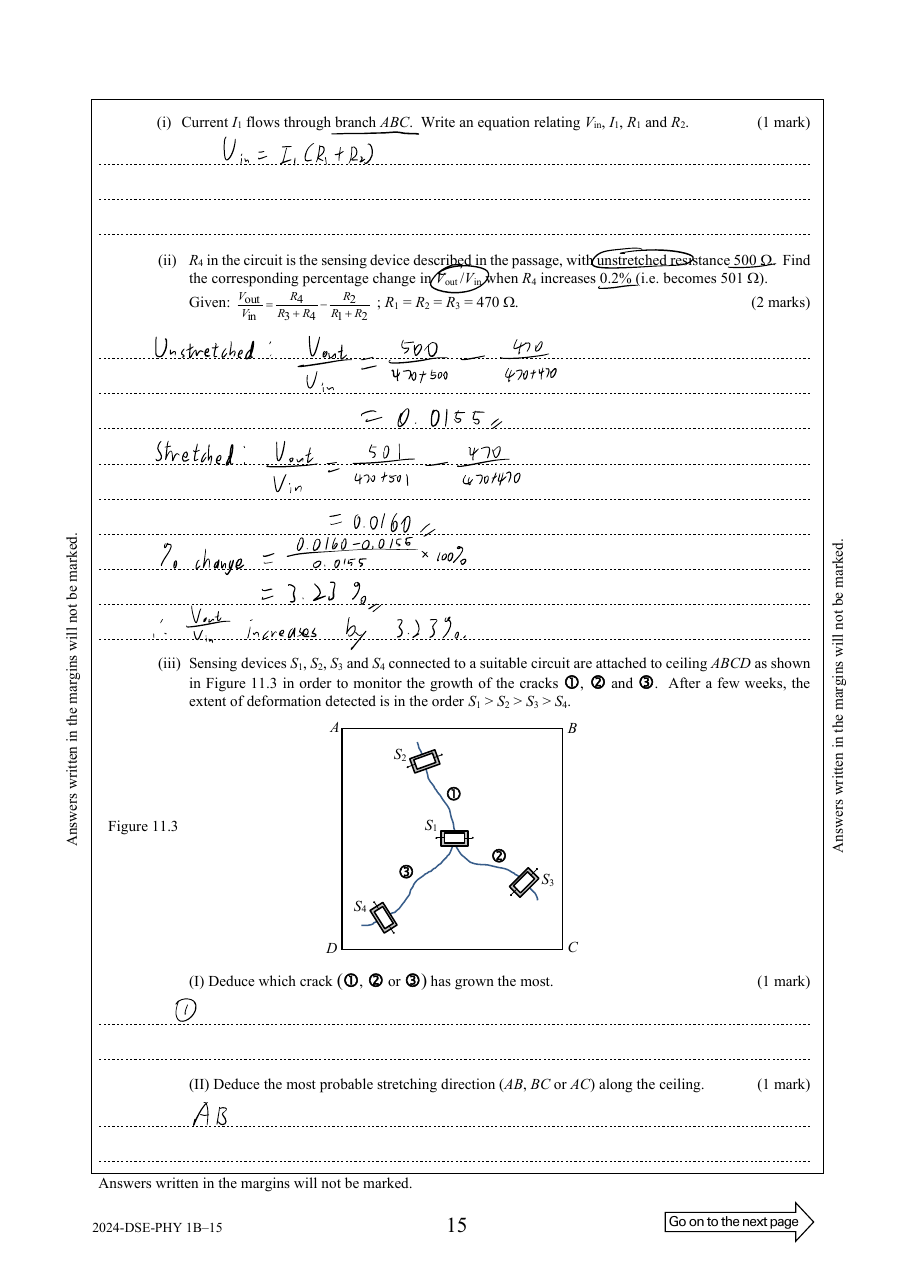
Correct expression for Vin: Vin = I1(R1 + R2). — Correct relation formula between Vin, I1, R1, and R2.
Substitution of values into the bridge circuit ratio formula for both 'before' and 'after' states. — Correct substitution of values into the bridge circuit formula for both unstretched and stretched states.
Calculate the percentage increase as approximately 3.23% (Accept ±(3.2~3.23)%). — Correctly calculated the percentage change as 3.23%, which falls within the acceptable range.
Identify crack ①. — Correctly identified crack ①.
Identify direction along AB. — Correctly identified direction AB.
第 15 頁
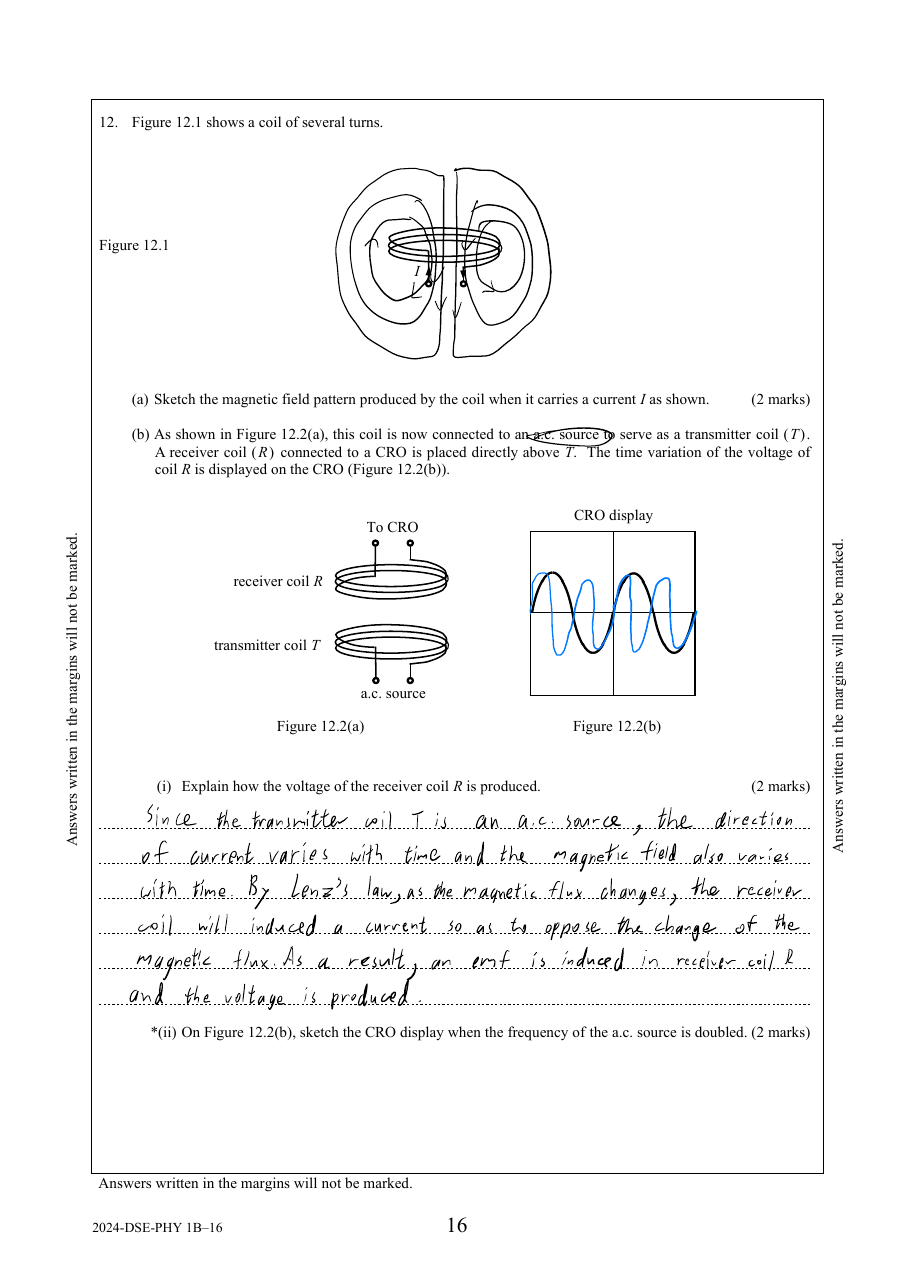
Correct field pattern (lines passing through the center and looping around). — 學生在 Figure 12.1 的線圈周圍加畫了多條連續的場線:兩側有由線圈上方繞到下方的大型圓滑迴圈,左右各有較小的內迴圈;另有近乎豎直的中間場線穿過線圈的中央區域,再向線圈兩側/外圍回繞。這些新增線條不是題目原有的橢圓線圈,並表達了場線穿過線圈中心及在外側回繞的線圈磁場閉合迴路圖樣。
Correct direction of field lines (pointing downwards through the center of the coil). Note: Also accept field lines pointing upwards for observers with different perception of current direction. — 學生在穿過線圈中央的豎直場線上畫有清楚箭嘴;在線圈中心下方的兩條近豎直線上,箭頭尖端均向下,表示磁場在線圈中心沿向下方向通過。這與 MS 圖中新加的中央場線箭頭向下相符;外側回繞線上的箭頭方向亦與此閉合方向一致。
Correct frequency (frequency doubled). — Inside the printed CRO rectangle, the student has added a blue sinusoidal trace with about four complete oscillations across the same horizontal time frame. The original printed black trace has about two complete oscillations across that frame, so the student's added trace explicitly shows doubled frequency.
Correct amplitude. — The added blue sine wave rises and falls by approximately the same vertical distance from the horizontal centre line as the original black wave: its peaks and troughs lie at roughly the same heights as the black peaks and troughs. In contrast, the MS-added high-frequency trace has approximately twice the original vertical amplitude, reaching close to the top and bottom boundaries of the CRO screen. Therefore the required changed amplitude is not shown.
The a.c. flowing in transmitter coil T generates a changing magnetic field. — Correctly stated that alternating current generates a time-varying magnetic field.
By electromagnetic induction, an induced e.m.f. is produced in receiver coil R to oppose the changing magnetic flux experienced by it. — Correctly stated that an induced e.m.f. is produced in coil R to oppose the changing magnetic flux.
第 16 頁
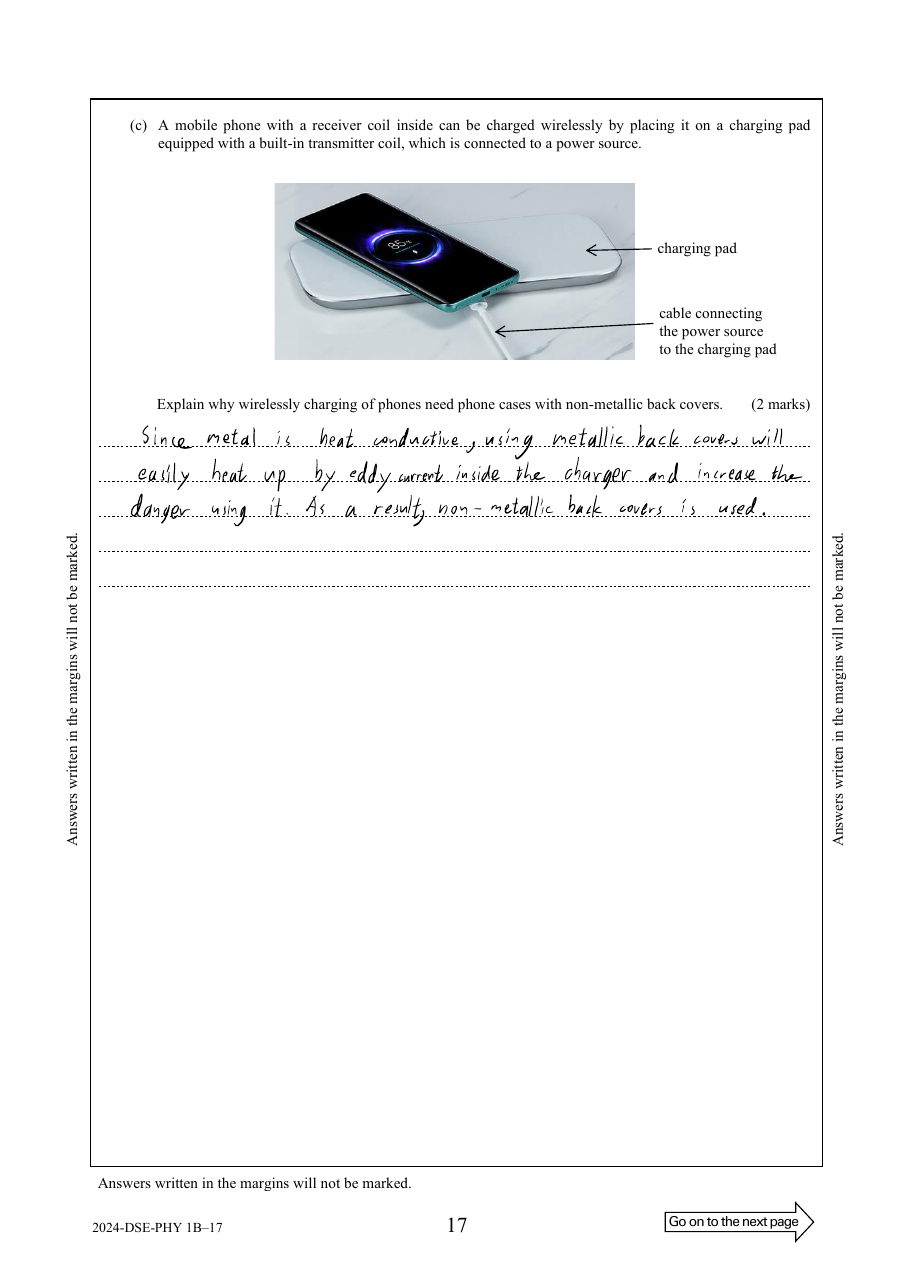
Metallic cover: eddy currents produced (by induction) OR Non-metallic: no eddy currents produced. — Incorrectly attributed eddy currents to the charger rather than explaining eddy currents induced in metallic cover / no eddy currents in non-metallic cover.
Metallic: loss of energy/flux blocked making charging impossible OR Non-metallic: energy loss minimized/field passes through easily. — Failed to state that metallic cover causes energy loss, blocks magnetic field, or makes wireless charging impossible.
第 17 頁
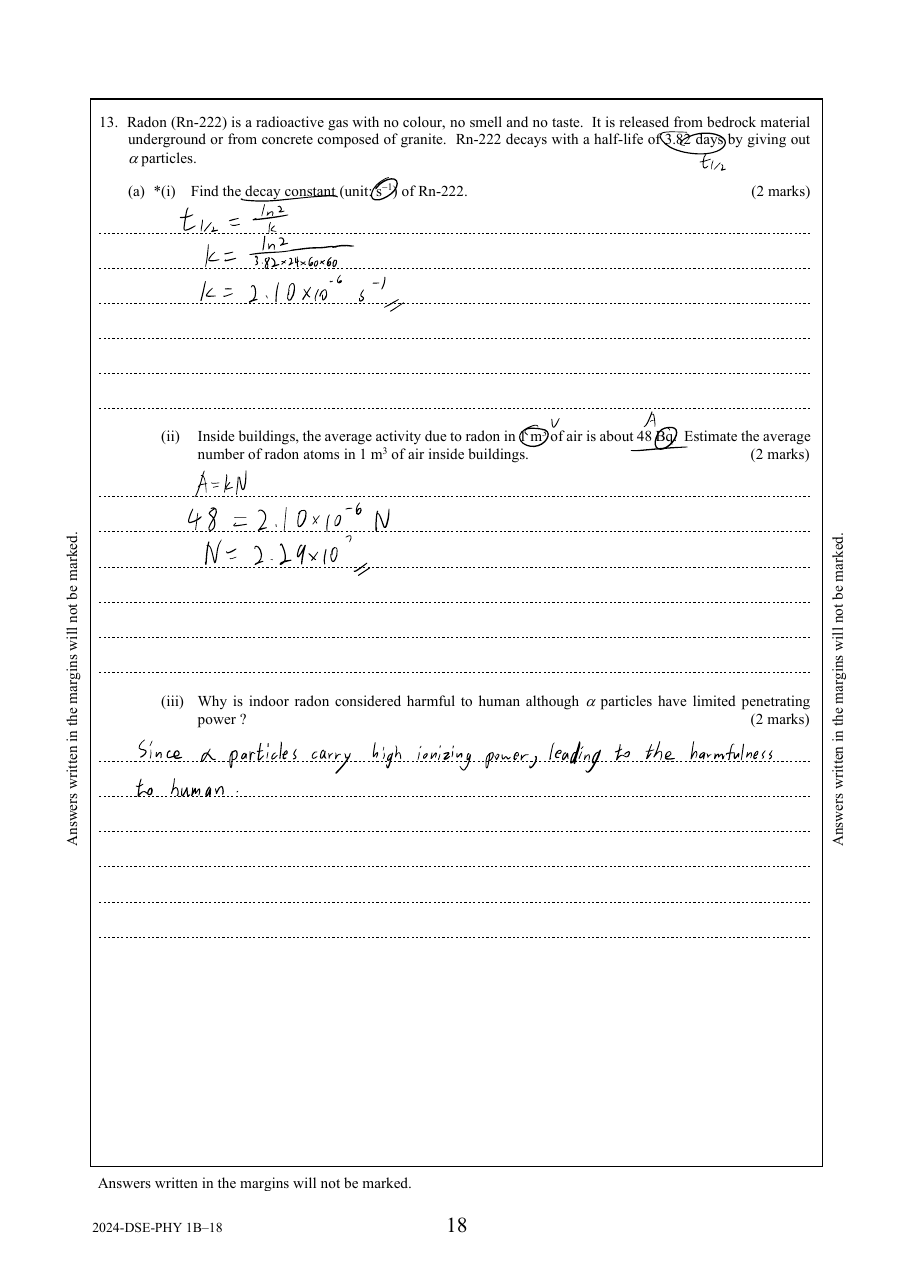
Substitution into k = ln 2 / t_1/2 with conversion of days to seconds. — Correct substitution into formula with conversion of days to seconds.
Final answer: 2.10 * 10^-6 (s^-1). — Correct final numerical value and unit.
Substitution into A = kN. — Correct substitution into equation A = kN.
Final answer: 2.29 * 10^7 (Accept: 2.28 ~ 2.3 * 10^7). — Final answer 2.29 x 10^7 is within the accepted range (2.28 ~ 2.3 x 10^7).
Strong ionizing power of alpha particles emitted might affect organs/cells nearby. — Correctly identified the high ionizing power of alpha particles.
Radon is a gas that can be inhaled into the lungs. — Failed to state that radon is a gas that can be inhaled into the lungs.
第 18 頁
第 19 頁
第 20 頁
以下題目已完成評分,但未能可靠地固定在原卷的某個位置,因此沒有猜測標記位置。
Draw a straight arrow from P pointing towards the center C. — 學生在 Figure 4.1(b) 的 P 點畫出一條直的斜線箭嘴,線由圓周左上方的 P 向左下方延伸,箭頭尖端在左下端。此線與由 P 指向 C 的半徑近乎垂直,為該位置沿逆時針轉動的切線方向,表示 P 剛離開球面時的瞬時運動方向。官方 MS 新加的答案箭嘴亦是由 P 向左下方的直線切線箭嘴,與學生一致;雖然 supplied point 的文字稱「towards C」,但 MS 圖及物理均顯示正確答案為切線方向。
[1/2] A sinusoidal wave pattern is drawn starting from the origin (0,0). — 學生在題目提供的方格內實際畫了一條連續、平滑的近似正弦曲線;曲線由左端原點/未受擾位置的交點開始,先向上形成波峰,之後穿越中線再形成波谷。雖然其起始走勢與MS新增波形的向下走勢相反,但本點只要求明確畫出由(0,0)開始的正弦波形,故滿足。
[2/2] The wave has a wavelength of 4 units (e.g., crossing the axis at 0, 2, 4, 6, 8) and an amplitude of 1 unit. — 學生曲線的峰值及谷值約距中線兩個小格,並非要求的振幅1單位;而且由第一個正峰至下一個正峰的水平距離約六個小格,非4單位。其過零位置亦約在0、3、6及8附近,未能符合要求在0、2、4、6、8過零的4單位波長。
Two rays originate from point O, bend away from the normal at the water surface, and enter the observer's eye. — In the student drawing, the oblique ray from O reaches the left surface point P and then continues as a straight refracted ray slanting upwards-left into the observer's eye, with an upward arrowhead. The vertical ray Q continues upwards from the water surface to the eye with an upward arrowhead. The oblique emergent ray is farther from the vertical normal than its underwater segment, consistent with bending away from the normal on leaving water.
Dashed lines extend backwards from the refracted rays to intersect at a point I, which is vertically above O and below the water surface. — As described in the visual check, the student has drawn a dashed backward extension from the oblique refracted ray at P downwards-right into the water. It meets the vertical Q-ray line at a point above O and below the water surface, and the student labels this intersection "I". This is the required virtual-image construction.
[1/2] Correct distribution of charges on sphere P: positive charges on the left side (near the rod) and negative charges on the right side. — 學生直接在左邊的球 P 內畫出電荷符號:球面左側有多個「−」,右側(面向 Q/帶負電棒的一側)有多個「+」。電荷位置及正負分佈與 MS 新加的電荷符號一致。
[2/2] Correct distribution of charges on sphere Q: positive charges on the left side and negative charges on the right side. — 學生直接在右邊的球 Q 內畫出電荷符號:球面左側有多個「−」,右側、最接近右方負電棒的一側有多個「+」。此為明確標示的正負電荷分佈,與 MS 圖中的 Q 相同。
Explain that tension is perpendicular to collision direction (horizontal) OR net force on system is zero because tension balances weight. — The student fails to explain that tension is vertical/perpendicular to the horizontal collision direction or that the net force on the system is zero.
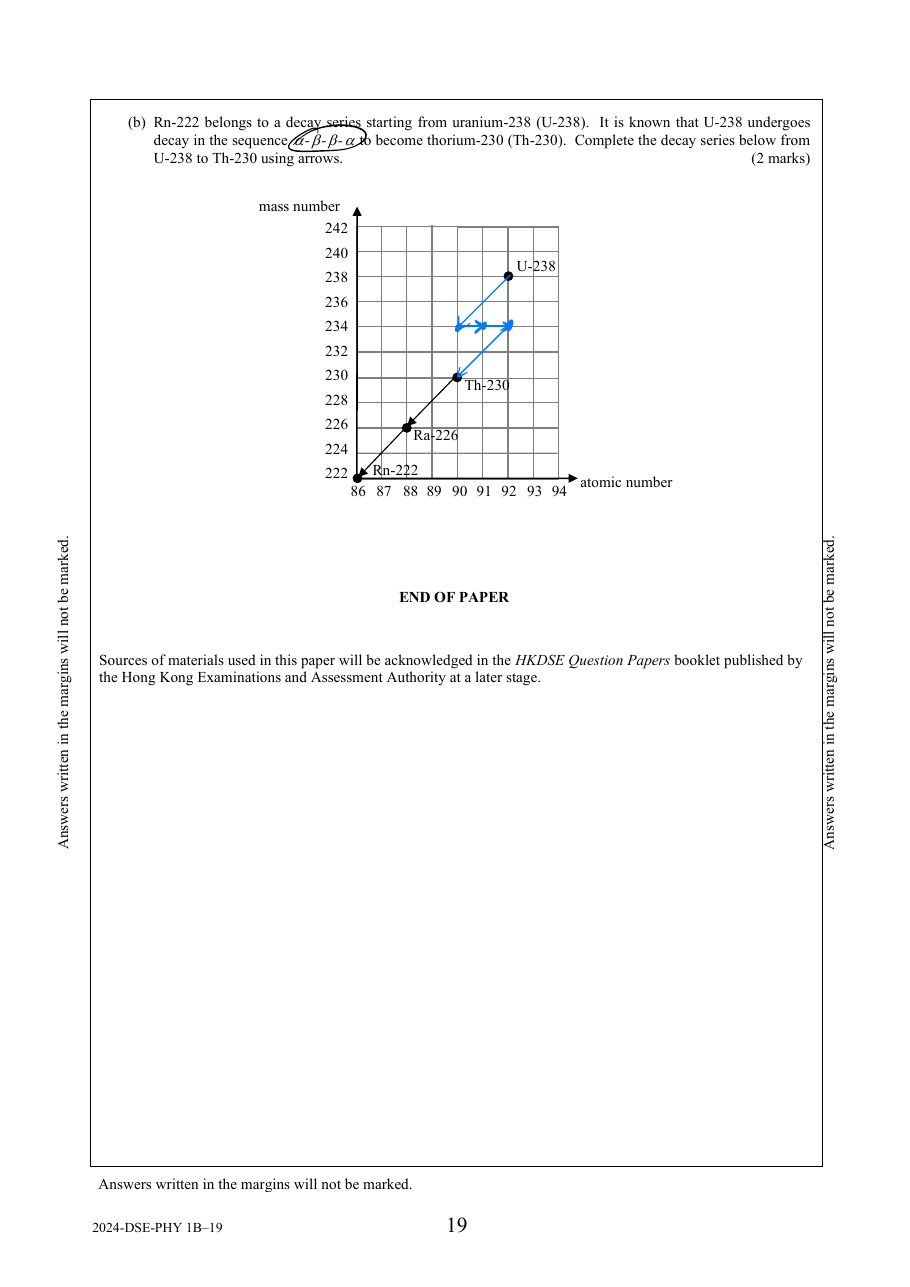
[1/2] Correct sequence of arrows representing alpha and beta decays on the grid. — In blue, the student draws a continuous arrow sequence from U-238 at (92,238): a diagonal down-left arrow to (90,234), two successive horizontal right-pointing arrows along mass number 234 from atomic number 90 to 91 and then to 92, followed by a diagonal down-left arrow ending at Th-230 at (90,230). These directions represent α, β, β, α respectively.
[2/2] Correct final position at Rn-222 (Atomic number 86, Mass number 222). — The final Rn-222 location at (86,222), including the arrowed route from Th-230 through Ra-226 to Rn-222, is black pre-printed material on the question graph. The student's blue additions stop at Th-230; no student-drawn arrow or endpoint mark explicitly reaches Rn-222.